Abstract
The purpose of this research is to determine the viability of unmanned aircraft operating in the National Airspace System. Currently, UAS are confined to certain airspaces to keep them from manned aircraft traffic. This document researches other documents to view the possibility of dangers from allowing unmanned aircraft to fly in the same airspace as manned aircraft. We will look at accident rates for midair collisions as a comparison to using UAS in the NAS.
Keywords: unmanned aircraft, manned, aircraft, limitations
Viability of Unmanned Aircraft Flying in the NAS
Flying unmanned aircraft in the National Airspace System has been a battle for the last two decades. The Federal Aviation Administration doesn’t want to allow unmanned aircraft to fly near or around manned aircraft due to safety concerns. Because of this concern, the FAA has ruled that unmanned aircraft must be operated in special use airspace and all non-participating aircraft must stay well clear of their operations. “Understanding the issues, trends, and influences of UAVs will be critical in strategically planning for the future airspace system.
Whatever form the UAV market takes, the airspace system—both domestic and foreign—should be prepared to accommodate its growth.” (DeGarmo, 2004) I believe that with adequate anti-collision capabilities on the unmanned aircraft, there would be less concern for collision and it would allow for a smoother integration into the NAS. The future of UAS is to fly alongside manned aircraft in the NAS. Their biggest hurdle is not building aircraft that can do it. The biggest problem this enterprise is going to have is integrating their aircraft with manned aircraft. If we can ensure that these UAS are safe to be near manned aircraft, we can open the skies to all operators of unmanned systems.
Literature Review
In the paper by R. Weibel, Data was collected by the Enhanced Traffic Management System and was looked over to determine the amount of traffic over a 24-hour period. This type of sampling was found to be inadequate. Using too small of a sample for statistical analysis gave inadequate results that skewed the information that was being sought after. This data was not 100% random as it did not cover aircraft that was flying below or off ATC’s radar. These areas can and will be used by unmanned aircraft. The data also did not represent a large enough time span of collected data. This should have been found after testing the statistical significance of the data and when the people running the test, looked at the samples collected.
If the tests had taken a larger and more random sample, I believe they would have had more sufficient data to help determine air traffic in the NAS. This data can be utilized to determine the actual dangers of having unmanned systems flying in all airspace. By knowing where the primary traffic is, we can help determine the certificates required in certain areas for flying. This is identical to how manned aircraft are determined to be viable for flying in certain airspace. In a paper by M. DeGarmo from MIT, establishing regulations for UAV system certification, flight operations, and ground controller qualifications is a primary solution for NAS integration. (DeGarmo, 2004)
“Federal law states that the Secretary of Transportation, “shall consider … assigning and maintaining safety as the highest priority in air commerce” “(Weibel, 2006) Because of this, the secretary of transportation is working to maintain safety in the skies. We don’t want to put human lives in danger to simply fly unmanned aircraft. In the last year, we have seen the requirements for unmanned systems start to roll out into the public. This slow transition is helping ease the public into the regulations that are being set into place. “As shown in Figure 1, the number of uninvolved fatalities in the general public due to scheduled and unscheduled air carrier operations ranges from 0 to 4 annually.” (Weibel, 2006). These numbers should be considered greatly for the argument of unmanned aircraft. They clearly show that in the beginning of air travel, there were many accidents. These have tapered off to an almost nonexistent record. Something to also note is the years in which this was collected. Technology has exponentially grown to increase our situational awareness when keeping aircraft safe and in the air.
“A review of air traffic management (ATM) related accidents worldwide, from 1980 to 2001, showed that ATM-related accidents account for 8% of all accidents (the ATM-related accident rate is 0.44 per million flights).” (Carvalho, 2009) These mid-air collisions could have been avoided if there had been better technology to assist the ATC controllers. With unmanned systems, we can have a more automated approach to controlling these aircraft. Most controllers can literally call the UAS operators on the phone to discuss things if they needed to go into greater detail of separation without clogging up the radios. This data shows that mid air collisions will continue to concern the FAA and the DOT until we can show data that proves that the danger has been mitigated.
According to Boeing research, between 2006 and 2015, there were 163 fatalities from mid-air collisions. This data was pulled from aircraft that were flown by pilots inside the aircraft. Comparing the data from the previous sources, we can see that there has been a dramatic decrease in aviation accidents. The data from Boeing also shows that a large portion of the accidents were in countries with outdated or nonexistent safety systems in place. The NAS has some of the most innovative and advanced systems for air traffic control. This continues to prove that our systems are ready to handle manned and unmanned aircraft flying in the same area.
Methods Used
For this research, I primarily searched for articles and papers that were investigating the implementation of unmanned systems into the National Airspace System. These papers produced information that showed we were considering certifying our fleets of unmanned aircraft to meet the highest safety requirements. The data that was shown on these papers indicated that the FAA has considered accident rates and how to mitigate them with better technology.
The data that was acquired was mid-air collision data from around the globe. This data came from Boeing and the FAA. The information indicated that a small portion of the midair collisions were ATC induced. I believe that this shows that the aircraft that are involved in these accidents are flying in areas without advanced ATC coverage. I also believe that the aircraft involved are not under ATC radar contact during the accident. This indicates that having unmanned systems flying around areas where general aviation is flying under non-ATC rules, would be an unacceptable risk to everyone involved.
Results
The data that Weibel showed in his report indicated that ground fatalities were almost completely gone. The initial data showed that there were several crashes that led to fatalities between 1984 to 1992. This shows that after 1992, the technology and practices used by air carriers improved drastically. This improvement in safety precautions will have led to decreased mishaps that lead to fatalities in the air and on the ground. With general aviation accidents in that period, there was relatively not change. This indicates that general aviation standards for safety did not follow the same flow as the airlines. This is something that is statistically significant. General Aviation accidents were drastically different that air carrier accidents. By utilizing this data, we can show that by improving safety on all aviation activities, we can help reduce fatalities involved in any aviation mishap.
Per Kuchar & Drumm from MIT, “We observed a total of 1725 RA events, corresponding to an average of 9 RAs per day, or about one RA every 116 flight hours.” This is an astonishing number to see. This data indicates that with a working state of the art safety system in place, pilots could avoid hitting another aircraft while following ATC directions. Even though this information can be concerning in certain areas, this is great news for aviation. This shows that technology has caught up and surpassed the current ATC framework. If we can continue to use the data as proof of the safety systems that unmanned aircraft can carry and utilize, we can show that it can and will be safe for these aircraft to operate near each other in the NAS.
Conclusion
Based on the research for this idea, I believe that having unmanned aircraft operate freely in the NAS is the future. I expect to see an uptick in the statistical analysis of aircraft traffic throughout the next few years. This will guide the FAA to determine how to appropriately take baby steps in allowing these aircraft to fly where they need to with certain requirements such as anti-collision instruments and software. I determined that the data indicates we will be safe to allow a small amount of highly advanced UAS into the NAS. These can be the first steps to allow our aircraft to enter the areas where other manned aircraft are operating without causing any danger.
I also believe that the current technology that it being utilized by all types of aircraft will help mitigate any safety concerns for operations in the NAS. If we continue to upgrade our systems and aircraft, we will likely see years and years of completely safe aviation operations. The data that has been gathered here, shows that we had a rocky start in aviation. Once the safety precautions were put into place, we could avoid any major mishaps that include aircraft midair collisions.
These UAS are the future of aviation. If we continue to fear them, we won’t grow as a community. If we look at back at our history and see that the aircraft that we fly today, were significantly more dangerous, we will see that there is much less to be concerned about regarding these unmanned aircraft. The statistics here do not lie. They show that we are able to come from a very dangerous time to one of the safest ways to travel in the world.
Appendices
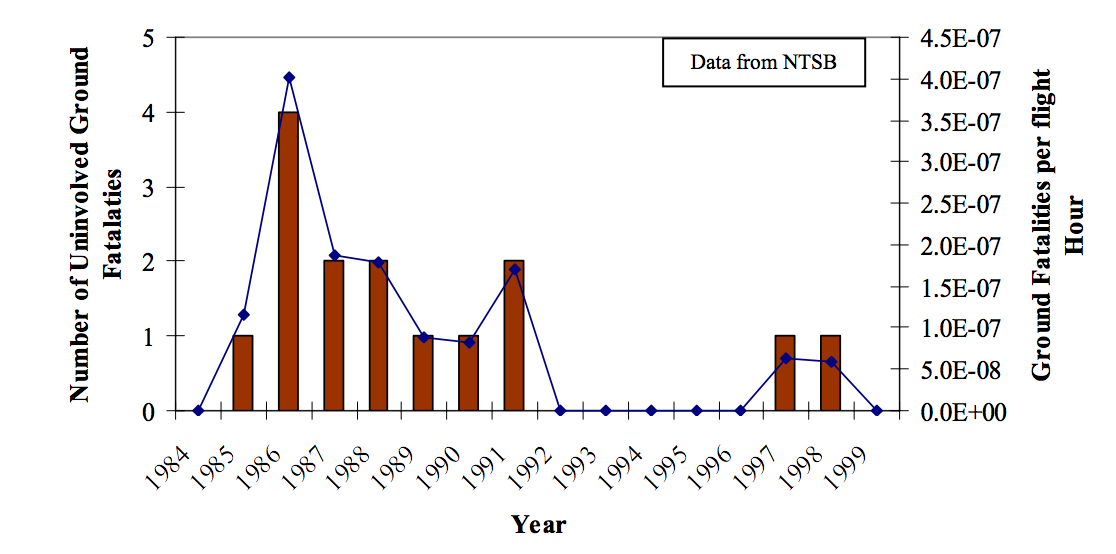
Figure 1: Uninvolved Ground Fatalities Due to Air Carrier Accidents (Weibel, 2006)
References
Boeing. (n.d.). Statistical Summary of Commercial Jet Airplane Accidents. Retrieved 2016, from http://www.boeing.com/resources/boeingdotcom/company/about_bca/pdf/statsum.pdf
Carvalho, Paulo Victor Rodrigues de, Gomes, J. O., Huber, G. J., & Vidal, M. C. (2009). Normal people working in normal organizations with normal equipment: System safety and cognition in a mid-air collision. Applied Ergonomics, 40(3), 325-340. doi:10.1016/j.apergo.2008.11.013
DeGarmo, M. T. (2004). Issues concerning integration of unmanned aerial vehicles in civil airspace. The MITRE Corporation Center for Advanced Aviation System Development.
Kuchar, J. K., & Drumm, A. C. (n.d.). The Traffic Alert and Collision Avoidance System. Retrieved December 18, 2016, from https://www.ll.mit.edu/publications/journal/pdf/vol16_no2/16_2_04Kuchar.pdf
Weibel, R. E., & Hansman, R. J. (2006). Safety considerations for operation of unmanned aerial vehicles in the national airspace system.